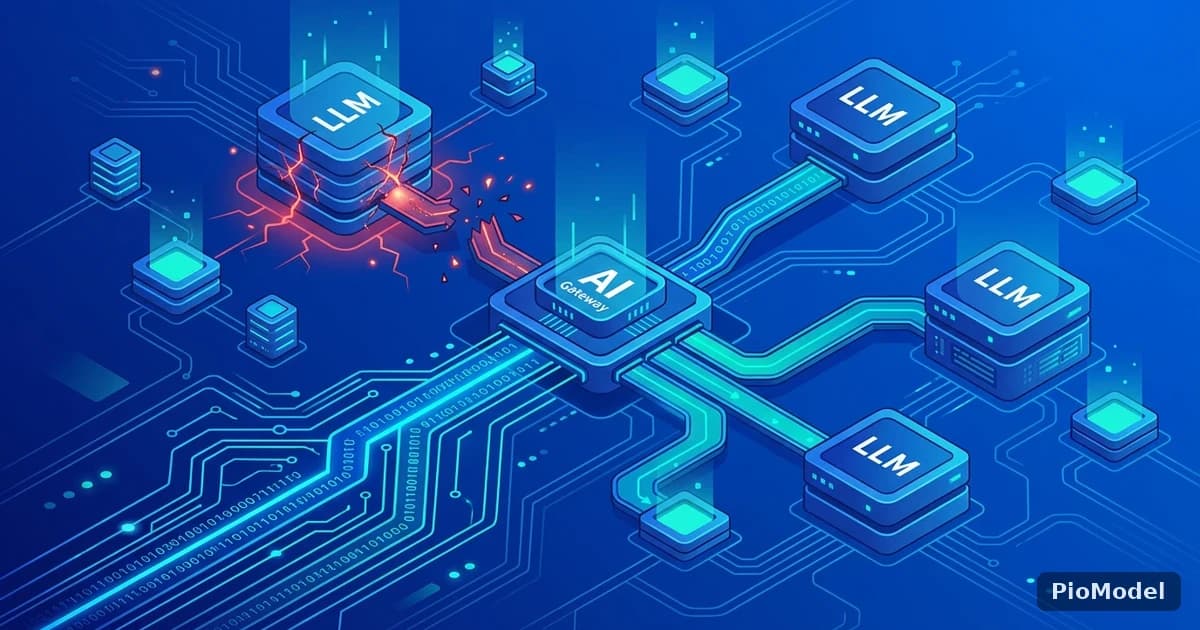
Every LLM provider has had an incident: a regional outage, a degraded-latency window, a rate limit tightened without much notice during a traffic spike. None of this is a knock on any specific provider — it's a property of depending on any single external service for something your product treats as core functionality. The question worth asking isn't "which provider is most reliable," it's "what happens to my feature when today's most reliable provider has a bad hour."
What actually breaks when a single-provider integration goes down
If your code calls one provider directly and that call fails, the failure mode depends entirely on what you built around it. Without a fallback, that's typically: the feature errors out, the user sees a generic failure message, and nothing recovers until the upstream does — with no visibility into how long that will take.
Why doesn't retrying the same provider fix this?
Retrying makes sense for a transient network blip, but not for a genuine upstream outage or a sustained rate limit — retrying against the same degraded endpoint just burns time (and sometimes quota) without improving the odds.
What a fallback chain actually looks like

A fallback chain is a simple ordered list: try Provider A; if that fails (timeout, 5xx, or a specific error class you've decided is retryable-elsewhere), try Provider B; if that also fails, try Provider C. The chain doesn't need to be elaborate — three tiers covers the overwhelming majority of real incidents — and the ordering can reflect cost or quality preference, not just availability.
Does this mean every request goes through the fallback logic?
No — in the common case, the primary provider succeeds and the fallback tiers never execute. The chain only matters on the tail of requests where the primary is degraded, which is exactly when it matters most.
Designing the chain: which failures actually deserve a fallback
Not every error is worth falling back on — treating a malformed request the same as an outage just hides real bugs behind a retry.
| Failure type | Fall back? | Why |
|---|---|---|
| Timeout | Yes | No response within a bounded time is a clear-cut signal to try the next tier |
| 5xx server error | Yes | Indicates an upstream-side failure, not a problem with the request itself |
| 429 rate limit | Yes | Retrying the same provider during a rate-limit window rarely helps |
| 4xx client error (bad request) | No | The request itself is malformed — a different provider will reject it too |
Should the fallback model be the same model, or a different one?
This depends on what the feature needs. A customer-facing chat feature might fall back from Claude to GPT with the expectation of near-equivalent quality; a cost-sensitive background job might fall back to a cheaper model on the assumption that degraded-but-answered beats not answered at all.
What you gain, concretely
- Requests keep succeeding through a single-provider outage instead of failing user-facing.
- Rate-limit spikes during traffic surges get absorbed by routing overflow to a second provider instead of queuing or dropping requests.
- You get a natural comparison point for free — the fallback tier's logs are a live check against the primary.
- Provider-side price changes stop being an all-or-nothing migration, since a second tier is already integrated and tested.
Why this is easier with one integration point
Building a fallback chain across separate provider SDKs means writing separate error-handling and retry logic for each provider's specific failure modes. Through a single OpenAI-compatible gateway, the request and error shape stay consistent regardless of which upstream model is being tried — the fallback logic is a routing decision, not a second integration.
PioModel connects Claude, GPT, DeepSeek, GLM, Kimi, Qwen, Llama, and Grok behind one API key and one consistent request format, so a fallback chain across providers is a few lines of routing logic rather than a second SDK integration to maintain.


Comments
Sign in to join the discussion